NSI-189, also called amdiglurax and developed as ALTO-100, is an investigational compound studied for depression and cognitive symptoms. Its reputation as a neurogenesis enhancer comes largely from laboratory research. Human studies give a less straightforward picture: early exploratory findings were encouraging, but larger depression trials did not meet their primary efficacy endpoints. [1][2][3]
What Is NSI-189 and Its Chemical Composition?
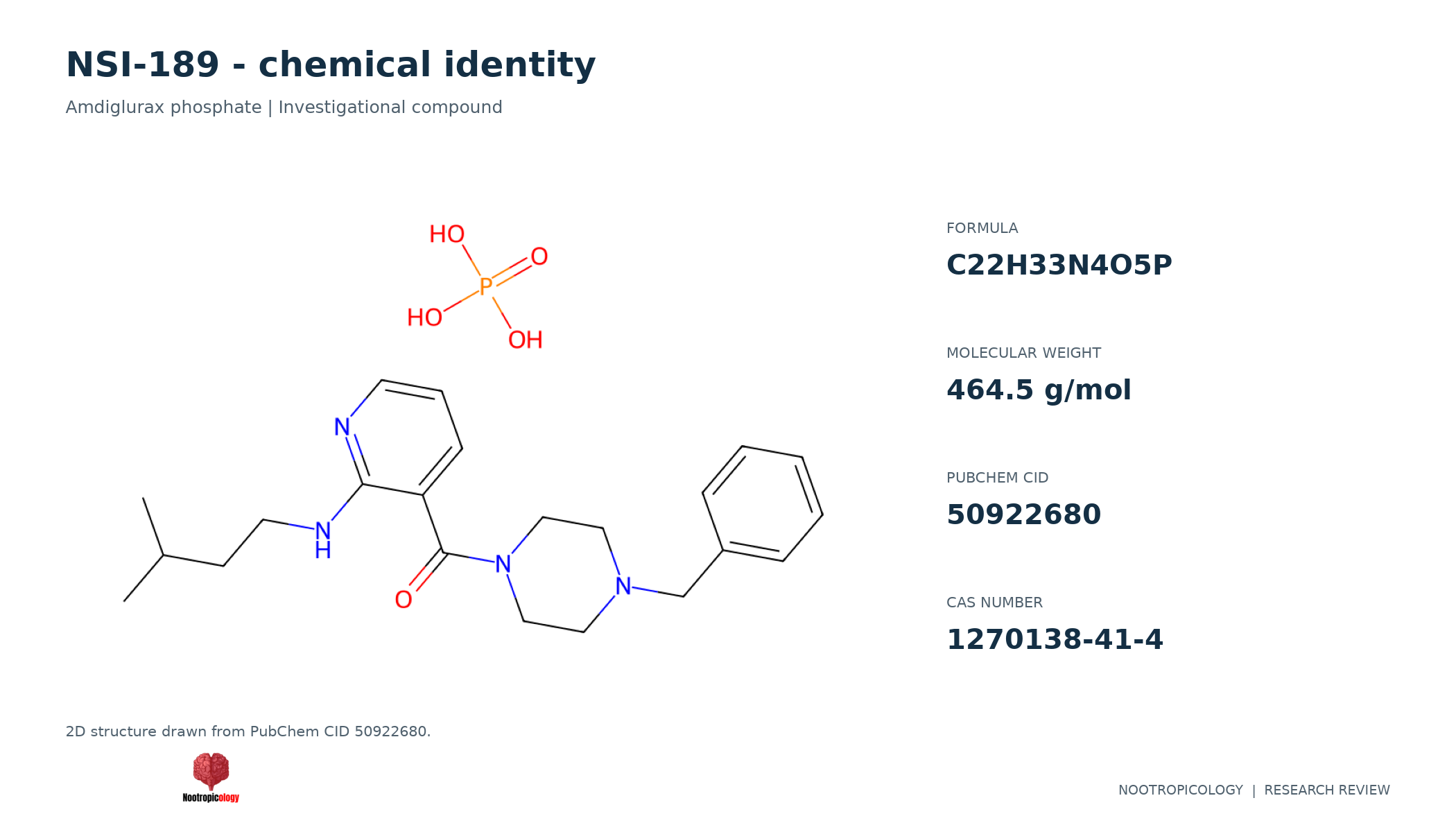
NSI-189 is a synthetic small molecule containing benzylpiperazine and aminopyridine groups. Its free base and phosphate salt have separate PubChem records and different molecular weights. [4][5]
| Identifier | Value |
|---|---|
| Name | NSI-189 phosphate |
| Synonyms | Amdiglurax phosphate; NSI-189 phosphate |
| CAS number | 1270138-41-4 |
| Molecular formula | C22H33N4O5P |
| Molecular weight | 464.5 g/mol |
| PubChem CID | 50922680 |
| InChIKey | LWHMGALTTIYPJU-UHFFFAOYSA-N |
| IUPAC name | (4-benzylpiperazin-1-yl)-[2-(3-methylbutylamino)-3-pyridinyl]methanone;phosphoric acid |
NSI-189 phosphate is a 1:1 salt. The free base has a molecular weight of 366.5 g/mol; the phosphate salt is 464.5 g/mol.
How Does NSI-189 Work?
NSI-189 was developed through research on neurogenesis, the formation of new neurons. Its clinical program subsequently examined depressive symptoms, cognitive performance, brain imaging, and pharmacokinetics. [1]
In a rat stroke study, investigators reported functional recovery alongside changes associated with neural repair. An Angelman syndrome mouse study examined synaptic plasticity and motor and cognitive outcomes. [6][7]
Neurogenesis concerns new neurons. Synaptic plasticity describes changes in communication between neurons. The NSI-189 research program has investigated both processes using cellular, tissue, and behavioral measurements.
The original screening program used human fetal hippocampal neural stem cells to identify molecules that increased neurogenesis. NSI-189 was then examined in healthy young adult mice, where investigators reported increased dentate-gyrus neurogenesis and hippocampal volume. This discovery strategy selected a cellular response rather than starting with inhibition of serotonin or norepinephrine reuptake, the mechanism targeted by several established antidepressant classes.
The hippocampus is involved in learning and memory, while its dentate gyrus contains neural precursor cells. The clinical program carried this anatomical focus into MRI measurements and cognitive testing. Those measurements address different features: MRI records regional volume, whereas computerized tasks record how accurately or quickly a participant responds.[2]
Does NSI-189 Increase Hippocampal Volume?
MRI measurements in the phase 1b trial showed no significant difference in hippocampal volume between the pooled NSI-189 and placebo groups at day 28 or day 84. The amygdala, used as a comparison region, showed similar trends. [1]
The imaging result is especially relevant because increased hippocampal volume was one of the preclinical observations that helped distinguish NSI-189 from other compounds in the screening program. In the human study, researchers pooled the active-treatment cohorts for the MRI comparison. The scans at the end of treatment and during follow-up therefore provide direct human anatomical results alongside the symptom questionnaires.[1]
NSI-189 Benefits and Clinical Trial Results
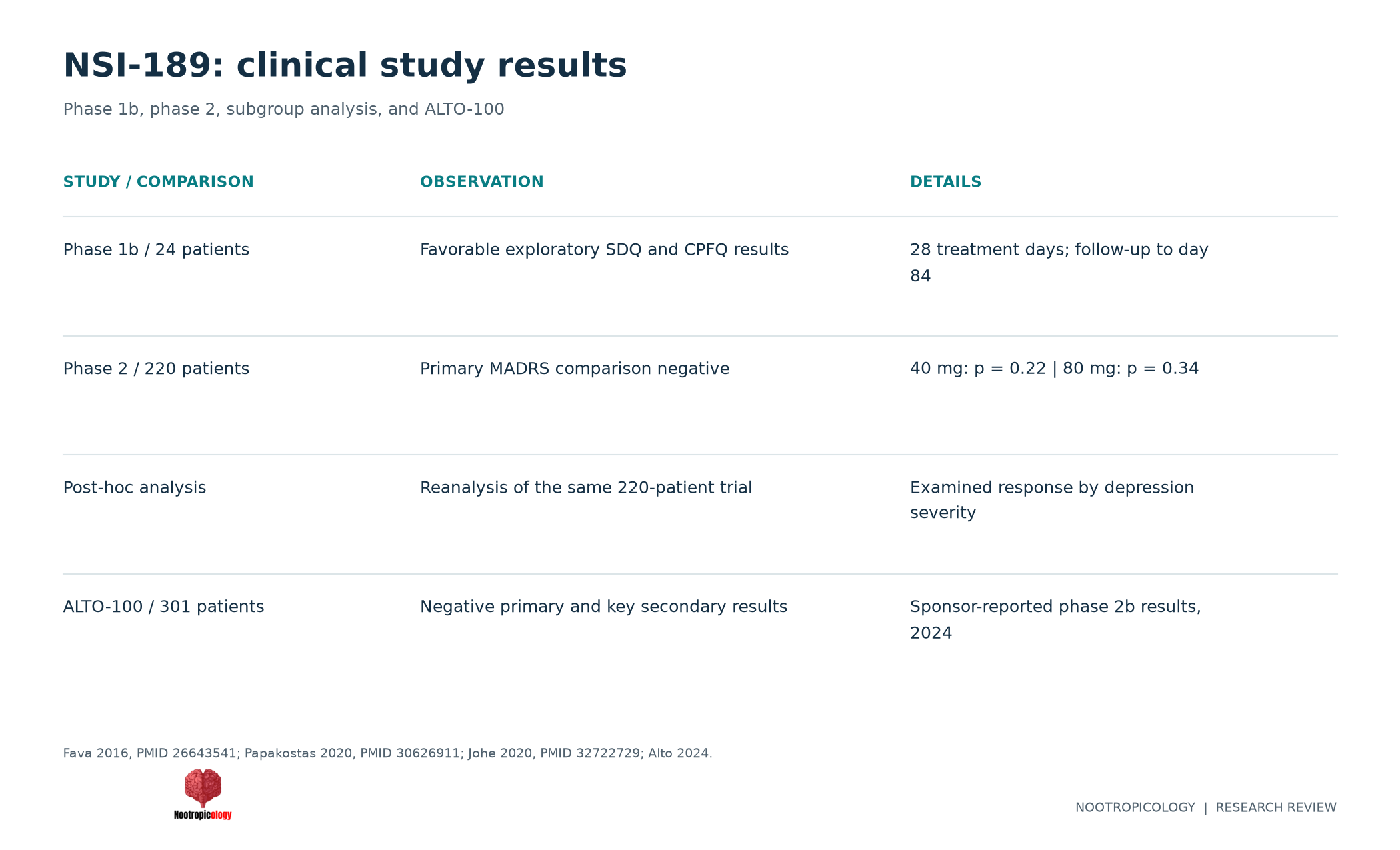
The clinical program includes a 24-patient phase 1b study, a 220-patient phase 2 study, and the later 301-participant ALTO-100 phase 2b trial. The early exploratory findings were followed by negative primary depression outcomes in the larger trials.
NSI-189 Phase 1b Trial: Early Exploratory Findings
Fava and colleagues enrolled 24 patients with major depressive disorder. Three cohorts received 40 mg once, twice, or three times daily, with 6 active-treatment patients and 2 placebo patients in each cohort. Treatment lasted 28 days, and follow-up continued to day 84. Exploratory SDQ and CPFQ scores favored NSI-189. [1]
A published correction replaced a duplicated efficacy figure and corrected an entry in a biomarker table. [8]
Participants stayed in an inpatient setting during the 28-day treatment period. Investigators assessed tolerability, collected pharmacokinetic samples, and repeatedly measured depressive and cognitive symptoms. Diagnosis and illness severity were confirmed through remote interviews. The three schedules corresponded to total daily exposures of 40, 80, and 120 mg.
Follow-up took place through outpatient visits after treatment ended. Improvements in the exploratory symptom measures persisted during that follow-up period. The study combined the six placebo recipients across cohorts when examining efficacy, giving the pooled comparison 18 active-treatment patients and 6 placebo patients. The larger outpatient trial subsequently tested two fixed daily regimens.[1]
NSI-189 Phase 2 Trial: The Primary Endpoint Was Not Met
The phase 2 study enrolled 220 patients and compared 40 mg/day and 80 mg/day with placebo over 12 weeks. The primary Montgomery-Asberg Depression Rating Scale (MADRS) comparison was negative for both regimens. Pooled differences were -1.8 points for 40 mg (p = 0.22) and -1.4 points for 80 mg (p = 0.34). [2]
Secondary patient-rated outcomes favored 40 mg/day on the Symptoms of Depression Questionnaire (SDQ) and Cognitive and Physical Functioning Questionnaire (CPFQ). The reported pooled differences were -8.2 points for SDQ (p = 0.04) and -1.9 points for CPFQ (p = 0.03). [2]
Researchers screened 353 people at 12 US sites before randomizing the 220 participants. Eligible patients were 18 to 60 years old, had a current major depressive episode lasting at least 8 weeks, and scored at least 20 on MADRS during screening and baseline assessments. The study investigated NSI-189 as monotherapy for major depressive disorder.
Its sequential-parallel comparison design divided the 12 weeks into two stages. Initially, 44 participants received 40 mg/day, 44 received 80 mg/day, and 132 received placebo. Placebo recipients who remained symptomatic after the first stage could enter a second randomization. Eligibility required less than a 50% MADRS reduction and a remaining score above 15.
This second stage reassigned eligible placebo nonresponders to either NSI-189 regimen or continued placebo. The primary analysis combined treatment estimates from the two stages. The clinician-rated Hamilton Depression Rating Scale, another depression endpoint, also showed no significant overall advantage. The favorable patient-reported findings were concentrated in the 40 mg group.[2]
NSI-189 Subgroup Analysis
Johe and colleagues reanalyzed the same 220-patient dataset by baseline depression severity. Their post-hoc analysis reported a more favorable response among moderately depressed patients. [9]
ALTO-100 Depression Trial Results
In October 2024, Alto Neuroscience reported topline results from a 301-participant phase 2b trial. The primary comparison focused on patients with a memory-based cognitive biomarker. Results were negative for the primary MADRS comparison and the prespecified key secondary analyses. [3]
Development continued in a separate bipolar depression program. In its second-quarter 2026 update, the company projected that trial's topline results for mid-2027. [10]
NSI-189 Depression and Cognitive Assessments
MADRS uses a clinician's assessment of depressive symptoms. SDQ and CPFQ record patients' experiences of symptoms and functioning. CogScreen and Cogstate assess performance on cognitive tasks.
Selected CogScreen measures favored the 40 mg group in the phase 2 study. Cogstate results showed no significant treatment advantage. [2]
| Study | Participants and duration | Reported result |
|---|---|---|
| Phase 1b | 24 patients; 28 treatment days; follow-up to day 84 | Favorable exploratory SDQ and CPFQ outcomes. |
| Phase 2 | 220 patients; 12 weeks | Primary MADRS comparison negative; selected secondary outcomes favorable. |
| ALTO-100 phase 2b | 301 participants | Negative primary MADRS and key secondary results reported by the sponsor. |
CogScreen included shifting-attention tasks, symbol-digit coding, delayed recall, and a previous-number task. Shifting-attention tests required participants to respond to changing rules, such as an arrow's color or direction. Symbol-digit coding assessed performance with paired symbols and numbers; delayed recall examined how well those associations were retained.
The investigators reported advantages on selected measures of mental flexibility, choice-reaction speed, and delayed recall of symbol-digit associations. They also examined responses following negative feedback. This is a more specific account of the cognitive findings than describing NSI-189 as improving memory across the board.
Cogstate used Detection, Identification, One Card Learning, and One Back tasks. The combined comparisons for these tasks were nonsignificant for both regimens. Within the patient-rated SDQ, favorable individual items included anxiety, mood responsiveness, decision-making, ability to work, and outlook on life. Removing the embedded CPFQ items from the SDQ calculation preserved the overall SDQ result.[2]
NSI-189 Memory Research
The human cognitive findings come from participants with depressive disorders. Researchers assessed both patient-reported cognitive difficulties and performance on standardized tasks.
Our Noopept review examines another compound studied for memory and neurotrophic effects.
In the stroke experiment, adult Sprague-Dawley rats began oral NSI-189 6 hours after middle cerebral artery occlusion. Treatment continued daily for 12 weeks, and improvements in motor and neurological deficits remained detectable up to 24 weeks after the stroke. Tissue analysis found increased microtubule-associated protein 2 (MAP2) staining, particularly in the hippocampus, consistent with greater neurite outgrowth.
The accompanying cell experiments used oxygen-glucose deprivation followed by reperfusion to model ischemic injury. NSI-189 reduced hippocampal cell death and increased the proliferation marker Ki67, MAP2, brain-derived neurotrophic factor, and stem cell factor. These experiments connect the behavioral findings with measured changes in injured neural tissue.[6]
The Angelman syndrome study examined a different experimental setting. NSI-189 increased theta-burst-stimulated long-term potentiation in hippocampal slices from both wild-type and Angelman-model mice. A short course of daily injections improved impaired motor and cognitive performance in the Angelman-model animals. The authors associated these effects with TrkB and Akt signaling.[7]
NSI-189 Dosage and Human Pharmacokinetics
In the phase 1b trial, plasma half-life ranged from 17.4 to 20.5 hours. Researchers measured concentrations using repeated blood samples. Overall exposure increased approximately in proportion to the administered dose. [1]
Half-life is the time taken for the measured concentration to fall by half. Under a simple elimination model, approximately 25% remains after 2 half-lives. Absorption and repeated administration also influence the concentration profile.
The trial reported exposure using area under the plasma concentration-time curve, or AUC. This measurement integrates the sampled concentrations over time. The nearly proportional increase across cohorts meant that higher administered regimens produced correspondingly higher overall measured exposure in that trial.
The study's once-daily, twice-daily, and three-times-daily schedules also made dosing frequency part of the pharmacokinetic comparison. Each administration contained 40 mg, while total daily amounts differed. The later phase 2 trial instead evaluated fixed daily totals of 40 and 80 mg over a longer treatment period. These are the regimens used in the clinical investigations, alongside the reported plasma elimination measurements.[1]
NSI-189 Side Effects and Safety
The 2024 ALTO-100 announcement listed headache, nausea, and abnormal dreams among the most common treatment-related adverse events, at similar rates to placebo. The sponsor reported no new safety signal. [3]
The earlier phase 2 trial reported no serious adverse events among participants randomized to NSI-189. During its first stage, neither active-treatment group had a discontinuation attributed to intolerance. During the second stage, intolerance led to one discontinuation in the 40 mg group, none in the 80 mg group, and one in the placebo group. Monitoring included laboratory tests, vital signs, physical examinations, and electrocardiograms.[2]
NSI-189 User Experiences and Reddit Reviews
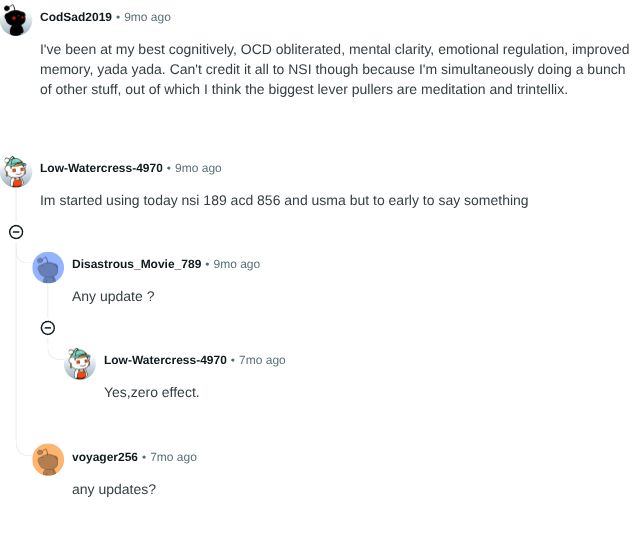
A February 2026 discussion in r/Nootropics contains sharply different NSI-189 experiences. One commenter described better mental clarity and emotional regulation, but also mentioned using vortioxetine (Trintellix) and practicing meditation. Another later reported no noticeable effect. [11]
Where to Buy NSI-189 Phosphate: Swisschems Product Details
Swisschems lists NSI-189 phosphate as 60 capsules containing 20 mg each. The listing designates it as a research product.
NSI-189 Review Conclusion
NSI-189's strongest early findings were changes in patient-reported symptoms. The larger depression studies returned negative primary outcomes, while selected secondary cognitive measures favored treatment. The ALTO-100 bipolar depression program continues that clinical investigation in a separate patient population.
Our nootropics guide compares other compounds studied for memory, attention, and mood.
Frequently Asked Questions About NSI-189
Common questions about NSI-189 concern its proposed mechanism, depression results, and reported side effects.
What Does NSI-189 Do?
NSI-189 is studied for effects on depressive symptoms, cognition, and neural plasticity. Laboratory and animal experiments have examined the formation of neurons and changes in communication between them. Human trials found some favorable secondary outcomes, but the larger depression trials missed their primary efficacy endpoints.
Is NSI-189 a Stimulant?
NSI-189 is an investigational antidepressant, rather than a conventional stimulant. Its development focused on neurogenesis and depressive and cognitive symptoms. The clinical trials assessed mood and cognition, not a stimulant indication such as promoting wakefulness.
Is NSI-189 Safe?
The long-term safety of NSI-189 is not established. The small phase 1b trial reported acceptable tolerability during its monitored treatment period. The 2024 ALTO-100 trial reported headache, nausea, and abnormal dreams at rates similar to placebo.
Is NSI-189 Neuroprotective?
NSI-189 has shown neuroprotective and neural-repair effects in animal research. A rat stroke study reported improved function alongside changes in neural tissue after treatment. A separate Angelman syndrome mouse study found improvements in synaptic plasticity and motor and cognitive performance.
What Are the Benefits of NSI-189 Phosphate?
The potential benefits of NSI-189 phosphate include improvements in selected depressive and cognitive symptoms reported in clinical trials. Early studies found favorable patient-rated outcomes, and the 220-patient phase 2 trial found improvements on some secondary measures. That phase 2 trial did not meet its primary depression endpoint.
- Fava, M et al. "A Phase 1B, randomized, double blind, placebo controlled, multiple-dose escalation study of NSI-189 phosphate, a neurogenic compound, in depressed patients." Molecular psychiatry vol. 21,10 (2016): 1372-80. doi:10.1038/mp.2015.178.
- Papakostas, G I et al. "A phase 2, double-blind, placebo-controlled study of NSI-189 phosphate, a neurogenic compound, among outpatients with major depressive disorder." Molecular psychiatry vol. 25,7 (2020): 1569-1579. doi:10.1038/s41380-018-0334-8.
- Alto Neuroscience. "Topline results from a phase 2b trial evaluating ALTO-100 for major depressive disorder." (22 Oct. 2024).
- National Center for Biotechnology Information. "PubChem Compound Summary for CID 50922681, NSI-189." PubChem (accessed 6 Nov. 2026).
- National Center for Biotechnology Information. "PubChem Compound Summary for CID 50922680, NSI-189 phosphate." PubChem (accessed 6 Nov. 2026).
- Tajiri, Naoki et al. "NSI-189, a small molecule with neurogenic properties, exerts behavioral, and neurostructural benefits in stroke rats." Journal of cellular physiology vol. 232,10 (2017): 2731-2740. doi:10.1002/jcp.25847.
- Liu, Yan et al. "Enhancement of synaptic plasticity and reversal of impairments in motor and cognitive functions in a mouse model of Angelman Syndrome by a small neurogenic molecule, NSI-189." Neuropharmacology vol. 144 (2019): 337-344. doi:10.1016/j.neuropharm.2018.10.038.
- Fava, M et al. "A Phase 1B, randomized, double blind, placebo controlled, multiple-dose escalation study of NSI-189 phosphate, a neurogenic compound, in depressed patients." Molecular psychiatry vol. 21,10 (2016): 1483. doi:10.1038/mp.2016.140.
- Johe, Karl K et al. "NSI-189 phosphate, a novel neurogenic compound, selectively benefits moderately depressed patients: A post-hoc analysis of a phase 2 study of major depressive disorder." Annals of clinical psychiatry : official journal of the American Academy of Clinical Psychiatrists vol. 32,3 (2020): 182-196.
- Alto Neuroscience. "Second Quarter 2026 Financial Results and Recent Business Highlights." (2026).
- Reddit contributors. "Has anyone had good experiences with NSI-189?." r/Nootropics (3 Feb. 2026).
source https://nootropicology.com/nsi-189/



No comments:
Post a Comment